
Starling
When the line between its life and mine becomes thin

I hear a strange noise and my breathing quickens, my hands curling around the top of my floral duvet until they hurt. Then silence. I lie there, trying to work out what it was, but before I can it comes again. My twelve-year-old imagination decides it sounds like some kind of space-age robot, powering up and down. I lie there for what feels like an age as the sound comes and goes in waves, each time convincing me it has stopped for good before returning. I am terrified.
Eventually I realise the noise is coming from directly above me. My bed sits beneath the large hatch into the attic, and after lying there arguing with myself, then I finally slide across the bed and reach for the long pole that fits into the latch of the spring-loaded door. Just as I am about to open it, the sound changes. It moves into the walls. There is scratching now. Scraping. I freeze, trembling, aware that I am alone in the house, before forcing myself to carry on, easing the hatch open and hooking the folding ladder down towards me.
The strange musty smell and trapped heat billow towards me. Normally the attic is one of my favourite places, full of boxes of history and hidden treasures, forgotten Christmas decorations and mysterious things whose purpose no one quite remembers. Even though my sister once drew the ghost she swore she had seen up there, I still love it. Today, though, my legs shake as I begin the climb.
The attic is large and boarded and, for a moment, I simply stand there listening until the noise comes again and my heart begins pounding so hard I can feel it in my throat. Even so, I move towards it.
Eventually, tucked into the eaves, I see it isn’t an evil robot after all, although it still takes me a few moments to steady myself. It’s a nest full of starlings, all oversized beaks and frantic wings, fledging noisily while their mother comes and goes. I stand watching long enough to realise that the strange mechanical sound rises and falls with her arrival, but then I notice something else. One chick seems to disappear. Then another.
I move closer. The smell of feathers and droppings catches in the back of my throat as I crouch down and realise what is happening. They aren’t disappearing. They’re falling. One by one they’re slipping down into the wall cavity.
Suddenly my heart is beating faster than it ever did at the thought of monsters in the attic. I know there is no way back from there. I imagine them trapped inside the walls, scratching and crying until eventually they fall silent, and all at once it becomes the most important thing in the world to save them.
I scramble back down the ladder and race through the house, pressing my ear against walls, then against the exposed floorboards in the living room, pacing helplessly from room to room trying to follow the sound. I have no idea where my mother or sister are. Eventually I go outside and stand beneath the house, staring up at the roof until I hear faint bird calls from somewhere near the ground. I crouch beneath the Firethorn hedge, whose orange berries fill with birds every autumn, but I can’t see anything. Then I spot it. A lattice airbrick.
The bird is behind it.
I push my fingers through the gaps and tug, but it’s cemented into the wall, so I race back through the house, banging doors open until I reach the disused outside loo where my mother keeps the tools. I grab the lump hammer and run back, kneeling on the earth as I blow through the gaps to frighten the bird away from the brick, praying I don’t hit it because there is nothing else I can think to do. It takes several swings before a hole finally appears. I peer into the darkness.
Nothing.
Defeated, I sit cross-legged on the earth beside the wall and wait. After a while the bird comes back. I move slowly, push my hand through the jagged hole, scratch my arm on the broken brick and somehow manage to catch it.
There were noises beneath the downstairs floor for the rest of that evening, coming from the dining room whose walls had no airbrick and no way for me to reach the birds trapped inside. When I finally had to admit to my mother what I had done with the lump hammer, I was in a world of trouble.
I didn’t put the rescued chick back into the nest. I didn’t know how to stop it falling again and, if I’m honest, I didn’t want to. I was only twelve and hadn’t yet learned the lessons nature has slowly taught me since: that sometimes the kindest thing you can do is step away so the mother can return, that some creatures are simply too wild or too young to help in the ways we imagine.
Instead, I kept it.
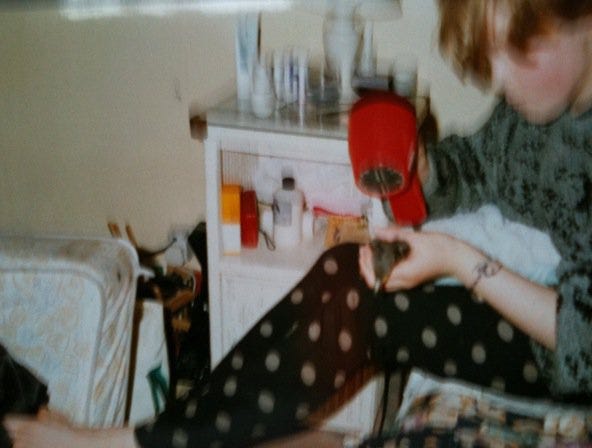
I bathed it because it smelled. I fed it cat food from the end of a teaspoon and eventually released it into the back garden, where it came to visit almost every day for six months before disappearing into the world it had always belonged to.
That was the first time I saved another living thing. It wasn’t the last, but it changed something in me.
Since then there have been rooks, fledgling robins pulled warm from a cat’s mouth, hedgehogs, bees lifted from hot pavements onto foxgloves before their tiny legs stopped moving, a mouse whose mother and siblings lay crushed beside a road, fed oat milk from the end of a paintbrush, a leveret the dog brought home unharmed, who grew up in the garden and boxed on the back door every morning for pine nuts before one evening returning to the field behind the house and never coming back, and most recently a tawny owl whose enormous eyes seemed to contain both ancient dignity and complete helplessness.
Some lived. Some didn’t. Every single one became, for a few hours at least, the reason for my existence.
People sometimes laugh. Last year a friend arrived on my doorstep holding an injured jackdaw because she knew I would save it.
I don’t think I’d ever stopped to ask myself why.
It’s tempting to make it about compassion, but that no longer feels like the whole explanation, and perhaps it’s a little too flattering. Plenty of kind people know that the best thing to do is often nothing at all. They understand where the line lies between helping and interfering.
I have had to learn that line the hard way. Something formed in the attic that day that had nothing to do with birds.
If something is frightened or lost, and I have seen it, then I am responsible.
I had no idea then how exhausting that equation would become.
It explains relationships that lasted too long because I confused staying with loving. I didn’t yet understand that love is not the same thing as persistence, or that walking away can sometimes be the kinder act. It explains why I find it almost impossible to walk past suffering, whether it belongs to a person, an animal or even an old house slowly surrendering to time, and why releasing what was never mine to keep has always felt dangerously close to abandonment.
The woods I walk through almost every day have been teaching me something different for years, although I have only recently begun to understand the lesson. I experience the woods as a living whole, governed somehow by different rules.
Every time I leave the path and push through brambles or shoulder my way into the bracken, they remind me that nothing there is trying to save everything. Fallen trees become homes. Dead pheasants become foxes. Rot becomes soil. Only last week I found a fledgling on the ground, already beyond saving, half returned to the leaf litter, and made myself leave it there.
The wood is full of endings that are also beginnings. Nothing is wasted, but neither is anything rescued from its place in the cycle simply because it is loved.
I still stop. I suspect I always will.
But now, when I kneel beside another small creature or gather it into a cupped hand, I am beginning to understand that what I am really protecting is not only the bird. I am protecting the twelve-year-old girl who heard scratching in the walls and felt sick at the thought of crying that no one else even knew existed.
Maybe that is why I keep returning to the woods. They don’t need another rescuer. They simply remind me, over and over again, that not everything can be saved, but that everything belongs.
Perhaps that is another way of understanding compassion: seeing another living thing so completely that, for a moment, the distance between you disappears.
"Not everything
can be saved.
But everything
belongs."
What she was
really rescuing
was never
only the bird.
It was the girl
who heard crying
no one else
could hear.
— AËLA
A story with a lot of heart ❤️