
River
I'm going to quit this crazy scene

My sister scowls as I tip more Matey into the bath and turn on the tap.
The bottle is blue and sailor-shaped, and the bubbles taste the way all forbidden things taste when you are little, chemical, exciting, probably poisonous. I scoop a handful into my mouth for comedic effect and chew them like meringue.
She does not laugh. Not yet.
She is sitting at the far end of the bath, lining up the shampoo bottles beneath the tiles with the grave concentration of a scientist preparing an experiment. The bathroom is damp and faintly furry, with floral green curtains at the window and tatty carpet round the bath, because it is the eighties and apparently no one has yet decided that bathrooms and carpet are natural enemies.
‘Pass the toothpaste,’ she says, barely looking up.
I pass the toothpaste.
‘Can I be the professor this time?’
I already know the answer. I ask anyway, because this is one of my little rituals of hope.
‘No. You are always the elephant.’
Of course I am.
I turn solemnly towards the taps and assume the position. This involves kneeling in the bath, pushing my wet hair out of my eyes and wiggling the rubber hose onto the taps. The hose is a cheap eighties workaround for a shower, relying entirely on tension and prayers. If you turn the water up too high, it shoots off and soaks the curtains, the carpet, the professor and the elephant. I know this. I still turn it up too high.
The hose bursts from the tap and sprays the room. Water hits the tiles, the mirror, the green curtains, the carpet. My sister shouts. I trumpet. She is trying not to laugh now, which is almost better than laughing, because making her lose her face is the point. The stony-faced professor is weakening.
I wiggle the hose off, flap my hose-trunk.
She laughs.
And there I am, where I want to be. Ridiculous, triumphant, useful.
The elephant.
We have always played roles, my sister and I. She was Garfield. I was Odie. She was the professor. I was the elephant, mixing diet potions in the bath for our sometime-delusional, sometime-golden mother.
She was the adult too soon. I was the court jester in our matriarchal hell house, eating bath foam, making fountains, breaking the tension before I had words for it.
Our mother was sometimes apple pie and Shakespeare, warm slippers and Christmas. Sometimes delusion, shouting, danger and eyes you read before speaking. In that house you listened to the stairs. You learned which version of her was coming by the sound of a footstep, a cupboard door, a breath.
My sister made herself clever and hard and older than she was. I made myself funny.
There are worse things than being the funny one. The funny one breaks the spell. The funny one gets a laugh from the hard face. The funny one makes the bath less frightening, the house less suffocating, the darkness less total. The funny one can turn a shower hose into a trunk and make herself ridiculous before anyone else can do it for her.
This is a useful survival mechanism if you are a child. Less useful, perhaps, if you are trying to become a woman you never let yourself know.
Because at some point the joke becomes a small room you are stuck inside. And you are still inside it, pressing your nose against the glass, stacking up jobs and degrees like proof, wondering why nobody has noticed that you are clever too. That you are real.
Later she became a scientist, studying the effects of THC on cannabinoids before returning to art. I became a writer, making fictional stories in real time and on the page, before returning to my own love of science. Perhaps we were always crossing the same ground from opposite sides.
She taught me to feel her face arrive before my own pleasure did. A song. A dress. A way of speaking. Anything too earnest, too soft, too pleased with itself, too Odie.
I pretended, as she did, that sung evensong was something to endure, though secretly I loved the smell, the cold stones, the choir notes rising into the vault. I hid my church dress fondness, though secretly I liked the beige florals and the funny concertinaed flowers. I learned to smuggle my own pleasure past her, as if joy were contraband.
This was not because she was wicked. It was because she was the only other person who knew the world we were growing up in, and I could not bear to be exiled from her too.
She told me once that there were gingham curtains in her Wendy house, before I arrived. That she loved them, that they were perfectly neat. Later they were folded and buried, along with pigtails shaken out too soon. Sometimes I still want to dig them up. To hold them to the light and remember who we were before.
But before what? Before Mum was ill? Before we knew she would never be properly well? Before Dad became a word we said carefully? Before I started doing little performances in the corner to keep the mood from turning? Before she learned to leave while still sitting beside me?
I don’t know.
The trouble with childhood is that by the time you understand what happened, the children who lived through it have already become adults with their own doors heavily bolted.
When Dad died, news of it reached me through a friend, not her. She had built a secret relationship with him, looking for answers in private, and left me outside. I cried my heart out and wondered where she had gone, where she had always gone. It was not only the news. It was the feeling of being outside the room where our shared life was being interpreted without me.
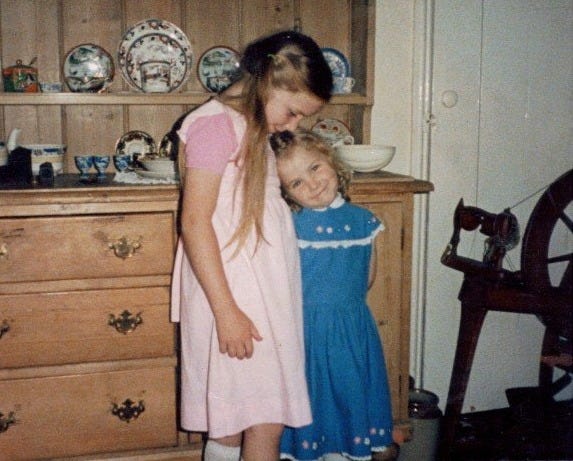
Christmas in our house was always, until recently, a little brighter. Mum usually put things aside then. She could hardly ever afford a car, so some years my sister and I walked the three miles home carrying a huge Christmas tree, hands sore, sharing a pair of gloves and laughing at the sight we made.
I loved that. I’ll love that always.
That is the difficulty. I cannot make the bad memories behave badly enough to erase the good ones. I cannot make the good ones strong enough to redeem the rest. They sit together, the way everything in our childhood sat together. Thomas Tallis and terror. Shakespeare and shouting. Warm slippers and slammed doors. A sister who shielded me, then vanished. A sister who laughed with me, then learned not to look.
My sister is the only one who could ever know what we lived through. The bathroom trunk. The professor, the elephant, the potions. The long walk home with the tree, sore hands, sharing a pair of gloves. The careful listening for which mother would come down the stairs. The strange golden patches, and how much worse they made the rest of it.
I think I have been waiting for her to say, yes, I remember. Yes, you were there. Yes, you were not just the funny one. Yes, I saw you too.
But perhaps she cannot. Perhaps looking at me would mean looking at herself. Perhaps my light feels like an accusation. Perhaps she had to decide I was stupid, because otherwise she would have had to admit that being hard was not the only way to survive.
Or perhaps that is my story, and I am doing it again, making meaning because meaning hurts less than silence.
She may never be ready.
And I am tired of standing in the hall with my little trunk and my handful of offerings, waiting for the hard face to soften. I am learning to like what I like before anyone clever has had a chance to sneer at it.
I like evensong. I like the smell of churches and cold stone. I like songs that are too sentimental if the ache is true. I like flowers on dresses. I like ridiculousness and joy and earnestness when it is real. I like the part of me that still points at the light out of the window.
I will always love the girls we were. The walk home with the tree, the shared glove, the sore hands, the two of us small and stubborn under a winter sky, carrying something far too big because nobody else was coming to help.
But I do not want to carry what is too big anymore.
I always think of you when I hear Joni Mitchell’s River. I wish I could give you one, long and cold and wide enough to skate away on, somewhere quiet, away from all of it. I love you darling, I always will. But I can’t keep waiting at the bank for you to jump in with me.
So I am stepping off the ice. Teaching my feet, at last, to fly.


Thank you 💓 Beautiful beautiful beautiful.
Sylvie, this is stunning in the way it lets the comic bath scene become the key to the whole childhood: the professor, the elephant, the foam, the hose, the laugh, and the small triumph of becoming useful through ridiculousness. The line between Garfield and Odie, cleverness and comedy, hardness and performance carries so much emotional force because it shows how siblings can survive the same house by becoming different kinds of armor. I was deeply moved by the longing for your sister to say, “Yes, you were there,” because that is the ache beneath so much of the piece: the desire to be witnessed by the only person who could fully know the world you both endured. The Christmas tree memory is especially powerful because it refuses easy sorting; the good memories and the frightening ones sit side by side, neither able to erase the other. Grateful for the beauty and courage here, especially in the final movement from waiting at the bank toward teaching your own feet to fly.