
I Was Wrong

The ground was still hard when it all began. Frost had lingered under the hedgerows throughout the previous day, but there was no sign of it now, and as I marched one of my familiar routes through the wood, it was warm enough to remove my coat and tie it around my waist.
The air was beginning to fill with the damp perfume of leaf litter and fungi, and I knew that winter was giving way to spring. Sudden blasts of cold would still arrive, but winter was in its death throes.
This gets me every year. After the long, dark, confining days, I feel the change in the air and get excited, rushing into the garden only to retreat again with numb, red fingers, or hurrying to the shop for plants and finding the shelves still bare because reality has not yet caught up with my enthusiasm.
But that year I did not go into the garden or to the shop, because something else was beginning to turn too.
I continued my walk, but something was wrong in me, a trapped feeling I could only describe as looking out from behind a mask permanently set in a frown, as though my face and the person behind it had become detached.
I had always been warm and tactile, but I was becoming cold and hard, even to the touch of my daughters, as frozen as the ground and the stiff trunks I passed, and I knew this was not right.
I guessed at something, something about the life I was living and the person I was living it with. I was not yet capable of naming even in my thoughts, and although I did not think it aloud, I knew it was in there somewhere, deeply buried like the snowdrops that would soon emerge.
I knew I could not look at it without unearthing everything that kept it there, and that I had to stand and face it bare like the fields.
I turned to writing.
I began at the start, digging my fingers deep into the soil, rifling through leaves, rotten wood and flint, and I wrote.
I wrote about the first memory of losing my father, a grief that was undisguised but unallowed, something I had learned to move around without disturbing, and I wrote into the early hours, sobbing over both the violence and the love of my mother, unwell in ways no one could explain to me. Beneath these memories there were others, the deprivation and judgement of my childhood, the abuse of past lovers, and my own actions, which I looked at last of all.
I thought I was writing to let go, and I thought I knew who the protagonist was.
At first, it was like waking up, and sometimes it was like coming home.
Spring came, then summer, autumn, and Christmas without cheer, then another spring and another summer, and the memories rose and receded over and over, just as the seasons do, just as the year turns, and each time I thought, now I can let go, now I understand.
But I was wrong.
It was never about letting go, and I still do not completely understand.
Now I am starting to think that uncovering darkness is not about digging it out and discarding it, but about accepting that it belongs to you in the way that soil belongs to a wood, as a deep place where new things can still be allowed to grow.
The questions I had not wanted to voice were bigger than I could ever have imagined, and there is never a conclusion to it all, not really. But you do eventually reach a place that feels at once strange and familiar and begin living from somewhere you were probably supposed to all along, even though a lifetime has already passed, several lifetimes, in fact.
There is no letting go, only a new way of looking at the way the year turns and the way your feet do.
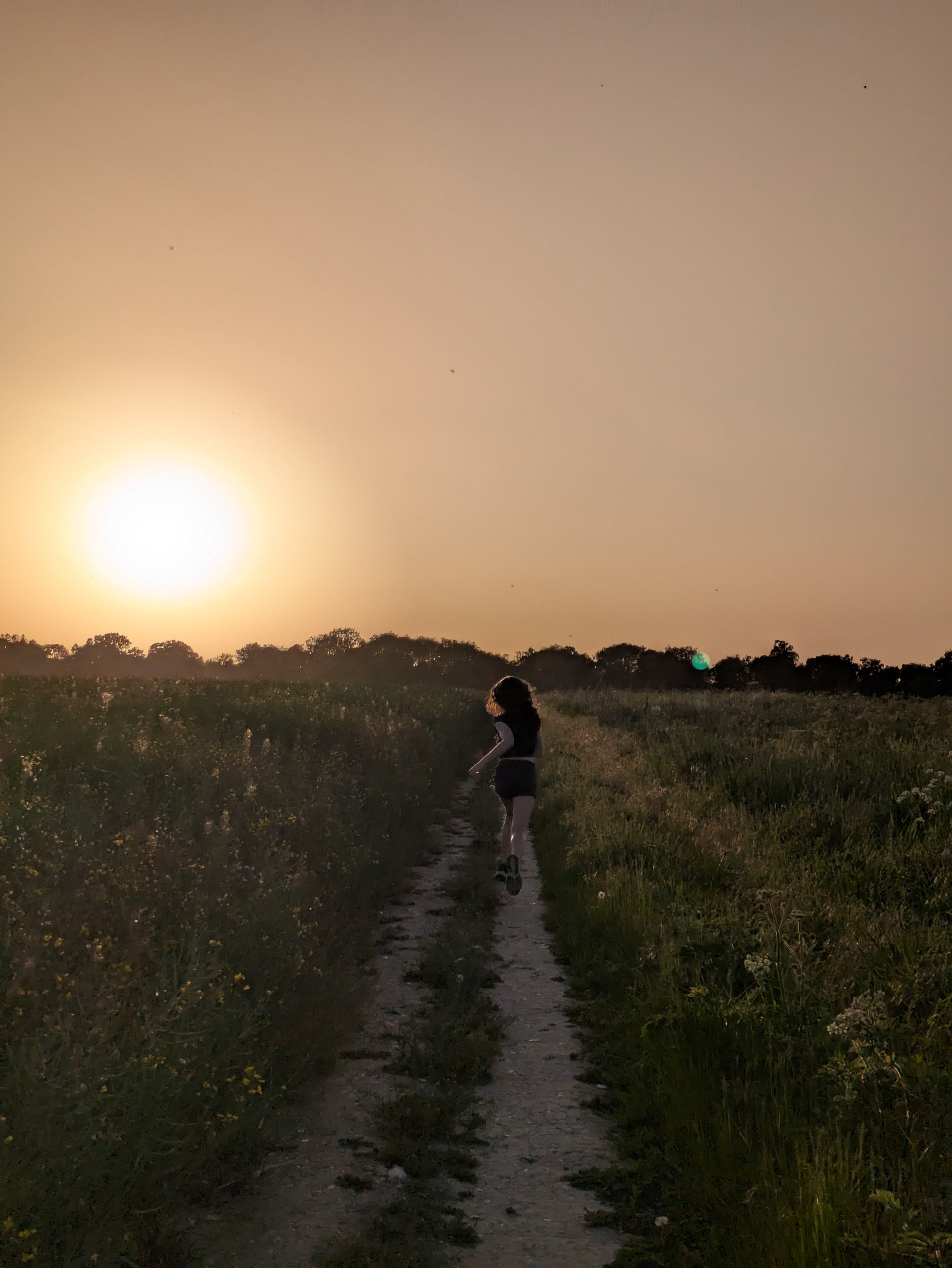
And tonight, all these months and seasons later, I walked across the late-summer fields and realised that I was here and only here, not trying to be anywhere else, while clouds made shapes in a turquoise sky, the sun began to set, and my daughter danced ahead with the dogs.
For this moment, I was content.
The protagonist, as it happens, was me all along.
She thought she was writing
to let go.
She was wrong.
She was writing
to finally recognize
who had been there
the whole time.
— AËLA
💙